
What Is an Operations System? A Plain-English Guide
An operations system is the connected layer that runs your stock, orders, production and reporting off one set of numbers. Here's what it is, what it replaces, and when you actually need one.
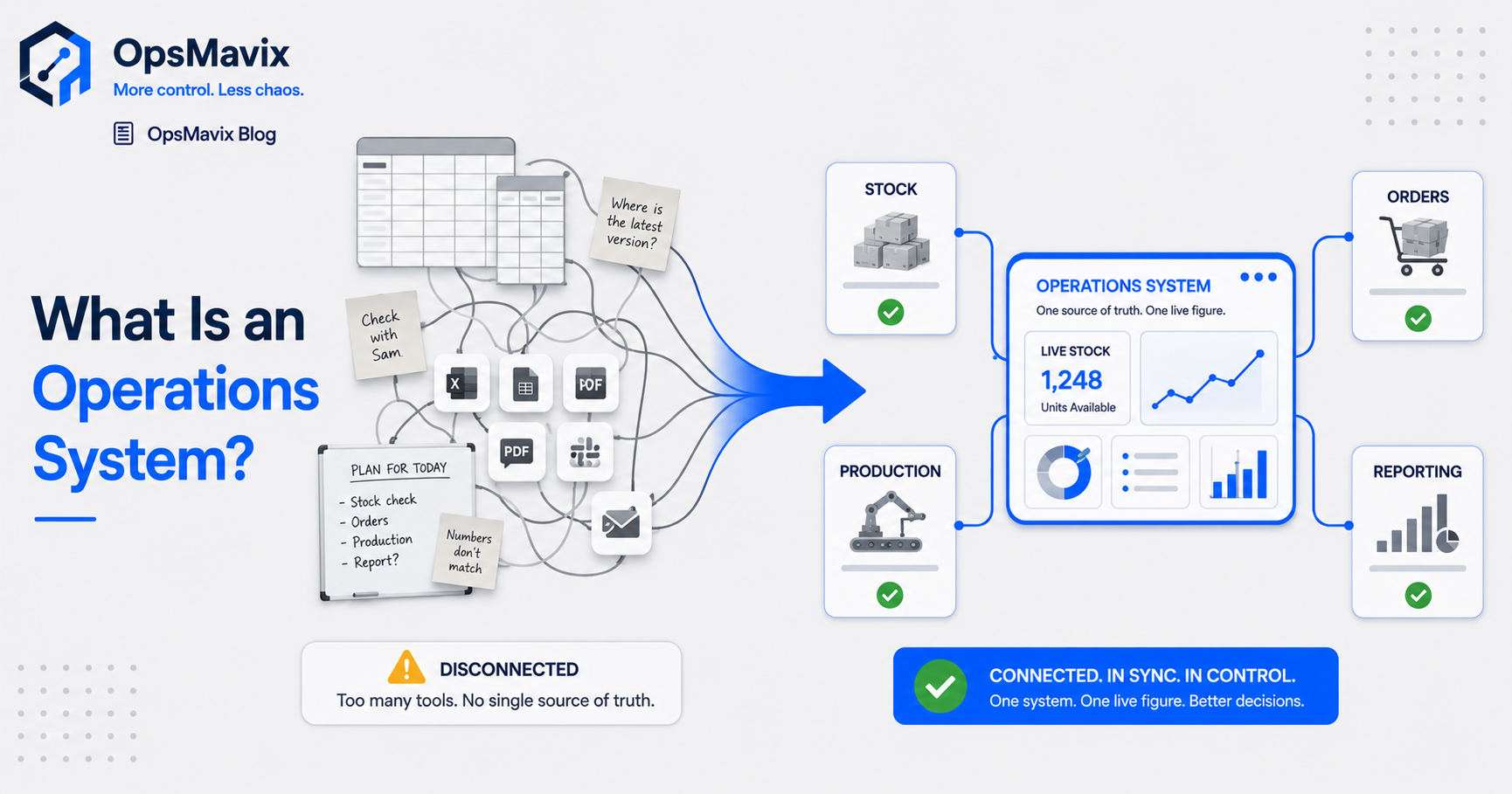
An operations system is the connected software that runs the day-to-day moving parts of a business — inventory, orders, production and reporting — off one shared set of numbers. Instead of stock living in a spreadsheet, orders in your inbox, and production on a whiteboard, every part updates the same live figures the moment something happens. It’s the practical layer that sits between outgrown spreadsheets and a full ERP.
Most growing businesses don’t decide to build one. They back into needing it. The spreadsheets that ran the place for years quietly stop coping, the tools don’t talk to each other, and the only thing holding it together is somebody re-typing numbers between screens. This guide explains what an operations system actually is, what it replaces, how it differs from both spreadsheets and an ERP, and how to tell when you’ve reached the point of needing one.
Key Takeaways
- An operations system connects stock, orders, production and reporting so they share one live set of numbers, instead of each living in its own tool.
- It’s the middle ground: more capable than spreadsheets, far lighter than a full ERP.
- The leak it fixes is re-keying and mismatched numbers — the same data typed into three places, none of which agree.
- You don’t need every part on day one. Most businesses start with the one area that hurts most and connect the rest later.
- The point isn’t features. It’s a single version of the truth the whole team can trust without checking it twice.
1What an Operations System Actually Is
Strip away the jargon and an operations system is one thing: software that captures every important movement in your business once, then shows it everywhere it’s needed. A sale is recorded, and stock drops, the picker sees it, the reorder figure updates, and the report reflects it — all from that single entry. Nobody copies the number into a second place, because there is no second place.
That’s the whole idea. A business runs on a handful of core flows — what you have, what’s been ordered, what’s being made, and what it all adds up to. In most growing companies each of those flows lives in a different tool that knows nothing about the others. An operations system is what joins them, so they behave like one system instead of four that happen to share a building.
2The Problem It Solves
The textbook description of the buyer is exact: a business “too messy for spreadsheets, not ready for a full ERP.” The work outgrew the tools, but the obvious upgrade — a six-figure enterprise system — is overkill. So the gap gets filled by hand.
You know the symptoms. The same order gets typed into the website, the accounts package, and a stock sheet. Returns get restocked in someone’s head. The “real” numbers live in a master workbook only one person fully understands, which makes that person a single point of failure the whole business quietly depends on. As one owner put it, the business is “run from my head,” and the first sign of a problem is a customer phoning to ask where their order is. An operations system removes the re-keying and the guesswork by making one capture serve every downstream need.
3The Core Parts of an Operations System
An operations system isn’t one rigid product. It’s a set of connected capabilities, and most businesses only switch on the ones they need:
- Stock and inventory — one live figure that matches the shelf, across locations and channels. This is where most businesses start, because it’s where the pain is loudest. See why your stock never matches the system and our inventory automation systems.
- Orders — sales and purchase orders entered once and visible to everyone, instead of re-keyed between an inbox, a spreadsheet, and accounts. This covers wholesale order management and eCommerce inventory automation.
- Production — for anyone who makes things, live job status, due dates and work-in-progress on one screen instead of a whiteboard, through production tracking.
- Reporting — the numbers from all of the above, pulled together into a dashboard that updates itself, so you stop rebuilding the same report by hand. That’s the operations dashboard.
The thread running through all four is that they share the same data. A connected system is more than the sum of its parts precisely because nothing has to be entered twice.
4Operations System vs Spreadsheets
Spreadsheets are brilliant, which is exactly why businesses ride them too long. They’re flexible, cheap, and everyone can use them. The problem isn’t the spreadsheet — it’s depending on a pile of them to run live operations.
A spreadsheet can’t enforce a process, can’t update itself when something happens elsewhere, and can’t stop two people overwriting each other’s numbers. It goes stale the moment the work moves on, and the knowledge of how it all fits together lives in one head. An operations system keeps the flexibility of “built around how we work” but adds the things a spreadsheet structurally can’t: real-time updates, one shared figure, and a record that doesn’t break when the person who built it is on holiday.
5Operations System vs ERP
Quick distinction, because it trips people up. An ERP is the big all-in-one platform — finance, HR, supply chain — built for large, complex organisations: powerful, but expensive and slow for a growing SMB, and you bend to it. An operations system does the operational core sized to your business, without the year-long rollout or the modules you’ll never use. Full breakdown: operational systems vs a full ERP.
6Signs You Actually Need One
You don’t need an operations system because you’re “supposed to” have one at a certain size. You need it when the manual workarounds start costing more than the fix. The clearest tells:
- You re-type the same data into more than one tool.
- You don’t fully trust your own stock or production numbers.
- Month-end, or a simple status question, means rebuilding a report by hand.
- One person is the only one who understands the master spreadsheet.
- You’re overselling, sitting on dead stock, or finding out about slipped jobs from the customer.
If several of those are familiar, the spreadsheets have already become the bottleneck. We cover the full list in the signs you need operational systems, and which systems to put in first in the operational systems every growing business needs.
7Off-the-Shelf or Built Around You?
Once you accept you need a system, the last fork is build versus buy. Off-the-shelf tools are quick to start but assume a standard shape, so you end up bending your process to fit the software and patching the gaps with — yes — more spreadsheets. A custom operations system is built around how you already work, and you own it outright: no per-seat tax that climbs as you grow, no vendor that can sunset it from under you.
Our view at OpsMavix is plain: don’t replace tools on principle, and don’t buy more system than the problem. Start with the one area leaking the most, connect it properly so the numbers are trustworthy, prove it, then expand. That’s how you get the value of a system without the cost and risk of a big-bang rollout.
FAQ
What is an operations system in simple terms?
It’s the connected software that runs the daily moving parts of a business — stock, orders, production and reporting — off one shared set of live numbers, so a single entry updates everywhere instead of being re-typed into separate tools.
Is an operations system the same as an ERP?
No. An ERP is a large, all-in-one platform built for big organisations, covering finance, HR and supply chain. An operations system focuses on the operational core, sized to a growing SMB, without the cost, complexity or long implementation of an ERP.
Do I need an operations system if I use spreadsheets?
Spreadsheets are fine until they’re running live operations across a team. If you re-key the same data into several places, can’t trust your numbers, or depend on one person’s master workbook, you’ve outgrown spreadsheets and an operations system is the next step.
How much of an operations system do I need at once?
Rarely all of it. Most businesses start with the single area causing the most pain — usually stock — get that trustworthy and connected, then add orders, production or reporting later as needed.
Should I build a custom operations system or buy an off-the-shelf one?
Buy off-the-shelf if a packaged tool genuinely fits how you work. Build custom when your process needs constant workarounds to fit someone else’s template, or when ownership and the ability to grow without per-seat fees matter more than a quick start.
How OpsMavix Can Help
OpsMavix builds custom operations systems for businesses that have outgrown spreadsheets but aren’t ready for a full ERP. We map how you already work, then connect the parts that are leaking — stock, orders, production and reporting — into one system that runs off a single set of numbers you can trust and own outright.
If you’re re-typing the same data between tools and second-guessing your own figures, that’s a measurable operational leak. Book an Operations Leak Audit and we’ll map exactly where your numbers break down and which system to put in first.