
What Is a Bill of Materials? A Plain-English Guide for Growing Manufacturers
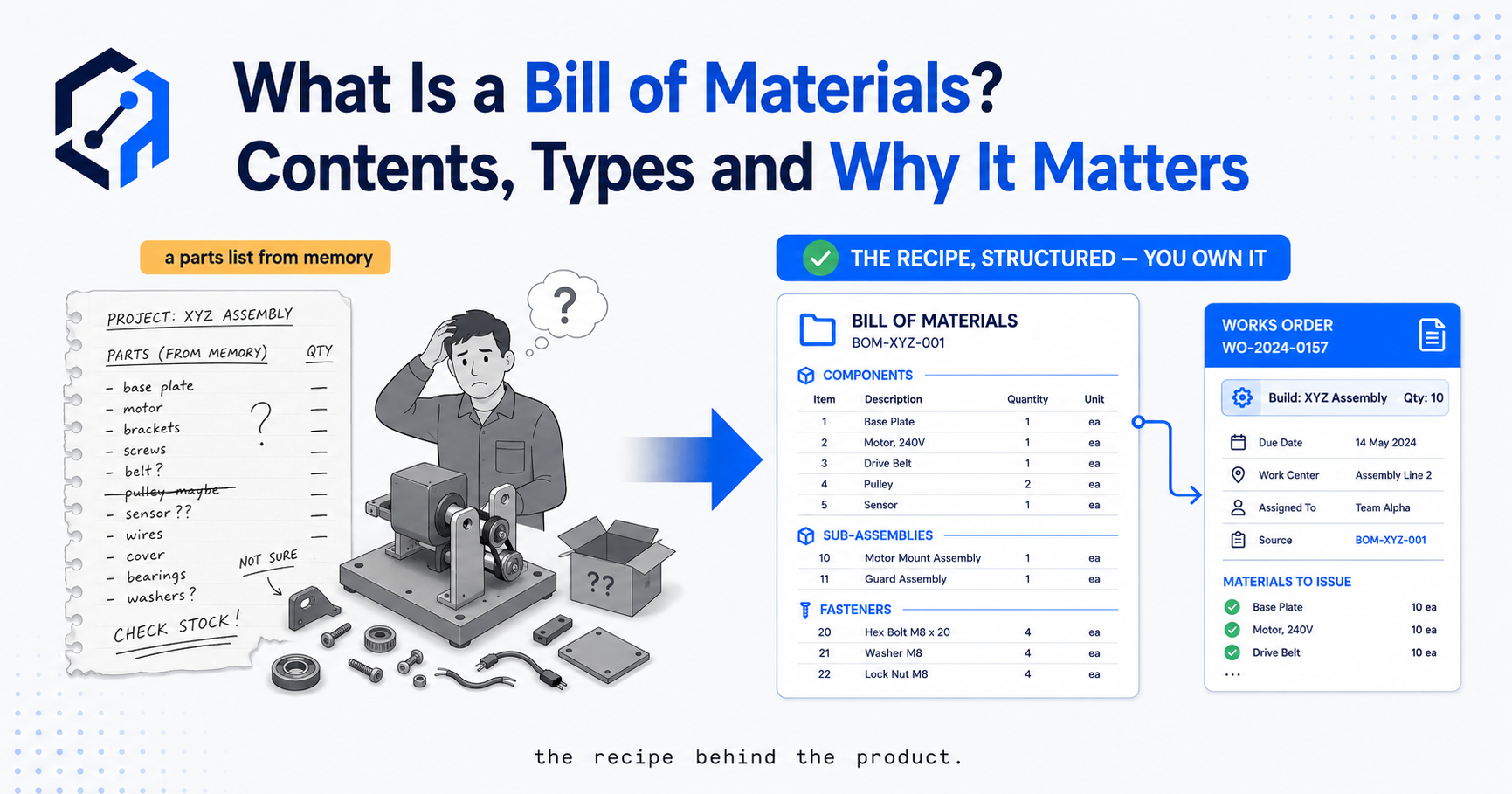
A bill of materials (BOM) is the master list of every component, sub-assembly and quantity needed to build one finished product. This guide breaks down what a BOM contains, the different types, and why an accurate one is the difference between a smooth build and a stalled production line.
By OpsMavix. Worked example and figures illustrative, checked September 2026.
A works order lands on the production floor for forty units of your best-selling product. Two hours in, someone finds there are only thirty of one fixing left in the stores, and nobody flagged it because the list the purchasing team ordered against was three revisions old. The line stops. Someone starts phoning suppliers for a next-day delivery of a part that costs pennies, while forty units of finished product sit half-built waiting on it.
That stoppage is what happens when nobody can answer, cleanly and confidently, what is a bill of materials for this product. This guide is a plain-English explanation of what a bill of materials actually is, what it should contain, the different types you will meet as a business grows, and a worked example that walks through a real product line by line. It is written for UK product businesses, from a two-person workshop to a multi-site manufacturer, and by the end you should be able to look at your own BOM and tell whether it is doing its job or quietly costing you money.
What is a bill of materials?
A bill of materials, usually shortened to BOM, is the complete, structured list of every component, raw material, sub-assembly and quantity required to build one unit of a finished product, together with notes on how it goes together. If a recipe tells a cook the exact ingredients and amounts for one cake, a BOM tells your production, purchasing and stock teams exactly what goes into one of your products, and how much of each.
At its simplest, a BOM is a table: one row per component, a quantity against each, and enough detail that two different people reading it would order and build the exact same thing. That sounds trivial for a product with five parts. It stops being trivial the moment you build something with dozens of components, several sub-assemblies, or more than one variant of the same product, because that is when the list stops living safely in one person’s head and becomes a document the whole business depends on.
The BOM sits upstream of almost everything else in a production business. Purchasing multiplies it by the production plan to know what to buy. Costing sums its lines at current prices to know what a build actually costs. Stock control uses it to know what to deduct when a job runs. Get the BOM right and each of those downstream jobs runs cleanly. Get it wrong, or let it drift out of date, and the errors show up everywhere at once, usually on the shop floor, usually at the worst moment.
What a bill of materials actually contains
A BOM that only lists part names is not doing enough work. A properly built BOM line typically carries:
- Part number or SKU: the unique identifier for the component, so there is no ambiguity about which bracket, which grade of steel, or which size of fixing is meant.
- Description: the human-readable name, useful for anyone reading the BOM without memorising every part code.
- Quantity per unit: how many of that component go into one finished product, stated precisely rather than rounded.
- Unit of measure: each, metres, kilograms, litres. A surprising number of BOM errors trace back to buying in one unit and consuming in another.
- Level or reference: whether the line is a raw material, a bought-in component, or a sub-assembly built in-house.
- Procurement type: whether the item is made on site or bought from a supplier, which determines whether it appears on a purchase order or a works order.
Better BOMs go further still, adding the assembly sequence, the workstation or operation each component is used at, and reference drawings or specifications. None of that detail is decoration. Each field answers a question someone in your business asks every single day: what do I order, how much does it cost, and what do I take off the shelf.
The different types of bill of materials
Not every BOM looks the same, because different teams need to see the same product through different eyes. A design engineer, a production supervisor, a buyer and a salesperson are all looking at the same physical product, but they each need a different structure of the same information.
| BOM type | What it is | When it is used |
|---|---|---|
| Single-level BOM | A flat list of every component that goes directly into the finished product, with no breakdown of sub-assemblies | Simple products with few parts, or a quick reference view where structure does not matter |
| Multi-level BOM | A hierarchy showing the finished product broken into sub-assemblies, and each sub-assembly broken into its own components down to raw materials | Any product built in stages, where sub-assemblies are made, stocked or costed separately |
| Engineering BOM (EBOM) | The BOM organised the way the product was designed, reflecting drawings and specifications | Product development, revision control, and communicating design intent |
| Manufacturing BOM (MBOM) | The BOM organised the way the product is actually built, including consumables, packaging and assembly sequence that the design view often omits | Production planning, works orders, and driving what the shop floor actually consumes |
| Sales BOM | A simplified, often single-level view tied to what is quoted and sold, sometimes bundling components that are built separately | Quoting, order entry, and configuring what a customer sees at the point of sale |
| Configurable BOM | A template BOM with defined options and rules, generating the correct specific BOM once choices are made | Products sold in variants, sizes or option sets, where every combination cannot be pre-built as its own BOM |
The gap between the engineering view and the manufacturing view is where a lot of businesses lose time. One production supervisor told us their design drawings never listed the adhesive, tape and packaging the line actually used, so those items never appeared on a purchase forecast and reliably ran short at the end of each month. The product had one design. It needed two different documents to run and to build it.
Worked example: the BOM for a bicycle
A concrete example makes the levels easier to see than any description does. Take a basic single-speed bicycle. A single-level BOM for it might list the following components that go directly into the finished bike.
| Component | Quantity | Notes |
|---|---|---|
| Frame | 1 | Made to order or bought in |
| Front wheel assembly | 1 | Sub-assembly, built from its own components |
| Rear wheel assembly | 1 | Sub-assembly, built from its own components |
| Handlebar assembly | 1 | Sub-assembly |
| Drivetrain assembly | 1 | Sub-assembly, chain and sprockets |
| Brake set | 2 | Front and rear |
| Saddle | 1 | Bought-in component |
| Seat post | 1 | Bought-in component |
| Fixings and cable ties | 1 set | Consumables, easy to under-order |
That list is enough to build one bike, but it hides where the real complexity sits. A multi-level BOM breaks the wheel assembly down further: one rim, thirty-two spokes, one hub, one tyre and one inner tube, plus the labour operation to lace and true the wheel. It breaks the drivetrain assembly down into a chain, a rear sprocket set, pedals and cranks. Each sub-assembly can now be costed on its own, built ahead of final assembly, and stocked as a semi-finished item if the business wants to build wheels in batches and hold them ready for final assembly.
This is the practical reason multi-level BOMs matter once a product has any real structure. If a supplier changes the spoke count on a hub, you correct one sub-assembly BOM and every finished product that uses that wheel inherits the fix automatically. With a flat single-level BOM, you would have to find and correct every finished-product line that happens to include that part, and it is easy to miss one. We cover this comparison in more depth, with an interactive walkthrough of how a BOM explodes from finished product down to raw material, in how a bill of materials works, and we go further into the single-level versus multi-level decision itself in single-level vs multi-level BOM.
Why an accurate BOM matters more than people think
The BOM is quiet infrastructure. Nobody notices it when it is right. When it is wrong, every job downstream inherits the error.
Purchasing. Your BOM, multiplied by your production plan, is your buy list. If a quantity is out by one, or a unit of measure is wrong, you either over-order and tie up cash in stock you do not need, or under-order and stop a job dead waiting on a low-value part.
Costing. A build’s material cost is the sum of its BOM lines at current supplier prices. If the BOM is missing lines, such as the packaging and consumables an engineering view often leaves out, every quote based on it is quietly under-priced, and the business absorbs the gap without ever seeing it on a report.
Inventory. When a works order runs, an accurate BOM tells the system exactly what to deduct from stock. Without it, recorded stock levels drift away from what is physically on the shelf until a full count forces an uncomfortable reconciliation.
Production. The BOM feeds the works order, the instruction that tells the floor to build a specific quantity of a specific product. A wrong BOM produces a wrong works order, which produces a wrong build, or a build that stops partway through.
A wholesaler-turned-assembler described the same failure recurring every quarter: a sub-assembly BOM listed four fixings when the real build used six. A tiny error on a component costing pence. Across a production run of a few hundred units it meant hundreds of missing fixings, an emergency courier order, and a line standing idle for half a shift. The part was cheap. The stoppage was not.
Where BOMs break in the real world
Almost every growing manufacturer starts with the BOM in a spreadsheet, and for a while that is entirely reasonable. The break happens at a predictable point: when the spreadsheet stops being the only place the information lives.
The pattern is familiar. The BOM sits in one workbook. Stock levels sit in another. Orders arrive through email and a separate system. Someone updates a component on the design side, but the purchasing copy of the sheet is not re-synced, and now two versions of the truth exist side by side. The floor builds from whichever version someone happened to print that morning.
The symptom is always the same: the numbers stop agreeing. What the BOM says you need, what the stock sheet says you have, and what is physically on the shelf tell three different stories, and reconciling them eats hours that should have gone into running the business.
The spreadsheet itself is not the problem. It is a tool that was never built to be a shared, live source of truth across purchasing, production and stock at the same time. It has no concept of “when this BOM changes, update the buy list” or “when this works order completes, deduct these exact components from inventory.” Someone has to make those connections by hand every time, and in a busy workshop, that step is the first one skipped under pressure.
From a document to a working system
A bill of materials on its own is a static document. Wired into the rest of your operation, it becomes the logic that drives purchasing, costing, stock deduction and scheduling automatically, without anyone re-keying the same numbers into three different places.
When a BOM is properly connected:
- Raising a works order checks live component availability against it before the job is scheduled.
- A shortage is flagged before the job starts, not discovered halfway through.
- Completing a build deducts the right components from stock the moment it finishes.
- Material cost per unit updates as supplier prices change, so quotes stay accurate rather than quietly stale.
Getting to that point is not about buying more software for its own sake. It is about deciding where your BOM should live and what it should be connected to, which is exactly what the interactive guide in how a bill of materials works walks through step by step.
A practical checklist for your own BOM
Work through these before deciding your BOM is fit for purpose.
- List every field each line actually needs: part number, description, quantity, unit of measure, level, procurement type.
- Check whether your business needs a multi-level structure. If you build anything in stages, or hold sub-assemblies in stock, a flat list is already hiding information from you.
- Confirm your engineering view and your manufacturing view agree, including consumables and packaging, not just the parts an engineer would draw.
- Ask where the BOM currently lives, and how many other places hold a copy of the same information.
- Trace what happens when a BOM line changes. Does purchasing see it the same day, or does someone have to remember to tell them?
- Check that a works order for the product actually deducts the right components from stock when it completes, rather than requiring a manual adjustment afterwards.
Frequently asked questions
What is a bill of materials in simple terms?
A bill of materials is the complete list of every part, raw material and quantity needed to build one unit of a product, along with notes on how it goes together. It is the recipe your purchasing, production and costing teams all work from.
What is the difference between a BOM and a parts list?
A parts list is often just names and quantities. A proper BOM adds structure: unit of measure, whether each item is made or bought, which level or sub-assembly it belongs to, and often the sequence it is used in during assembly. A parts list tells you what. A BOM tells you what, how much, and how it fits together.
What is the difference between a single-level and multi-level BOM?
A single-level BOM lists every component that goes directly into the finished product in one flat list. A multi-level BOM breaks the product into sub-assemblies, and each sub-assembly into its own components, down to raw materials. Multi-level BOMs matter once a product is built in stages or sub-assemblies are stocked separately.
What is an engineering BOM versus a manufacturing BOM?
An engineering BOM (EBOM) reflects how a product was designed. A manufacturing BOM (MBOM) reflects how it is actually built on the floor, including consumables, packaging and assembly sequence that a design drawing typically leaves out. Many production problems trace back to these two views quietly disagreeing.
Who is responsible for maintaining the BOM?
It varies by business, but usually design or engineering owns the initial structure, while production and purchasing need to be able to flag when the real build differs from what is documented. The important thing is that one BOM is treated as the current source of truth, rather than several teams each keeping their own copy.
Can a spreadsheet BOM work for a small manufacturer?
Yes, and for a business making one or two simple products it is often genuinely fine. The point to watch is when the spreadsheet stops being the only place the information lives, meaning stock, purchasing and production each hold a separate copy that can drift out of sync with each other.
How does a BOM affect product costing?
A build’s material cost is the sum of its BOM lines at current prices. If a BOM is missing components, such as packaging or consumables, or a quantity is wrong, every quote based on it is inaccurate, usually understated, and the gap is absorbed silently rather than showing up as an obvious error.
Does a BOM need to include labour and assembly steps?
It does not have to, but a manufacturing BOM that includes the assembly sequence and the operation each component belongs to gives production a far more complete instruction than a parts list alone, and reduces reliance on one person’s memory of how the build actually goes together.
How OpsMavix can help
Go back to the stopped line at the start of this guide: forty units held up because a stock figure and a BOM disagreed, and nobody found out until the job was already running. That is not a BOM problem on its own. It is what happens when a BOM, stock levels and a works order each live in a different place and nobody has connected them.
OpsMavix builds operations systems for UK product businesses, including manufacturing production tracking that keeps your bill of materials, stock and works orders talking to each other, so a shortage is flagged before a job starts rather than discovered halfway through it.
If your BOMs currently live across spreadsheets, memory and a system that does not talk to your stock, bring a real example to a free Operations Leak Audit. We look at how a specific product is actually built and costed today, and give you an honest read on where the gaps are and what fixing them would involve. You can also review current project price bands before getting in touch. Either way, the goal is a bill of materials your whole business can trust, not just the person who first wrote it.