
Manhattan vs Blue Yonder: How Two Enterprise WMS Giants Actually Compare
Manhattan Active WM and Blue Yonder WMS are both top-tier enterprise warehouse systems built for high-volume, automation-heavy operations. This guide compares how they differ, what they cost, and how to tell whether your warehouse actually needs either one yet.
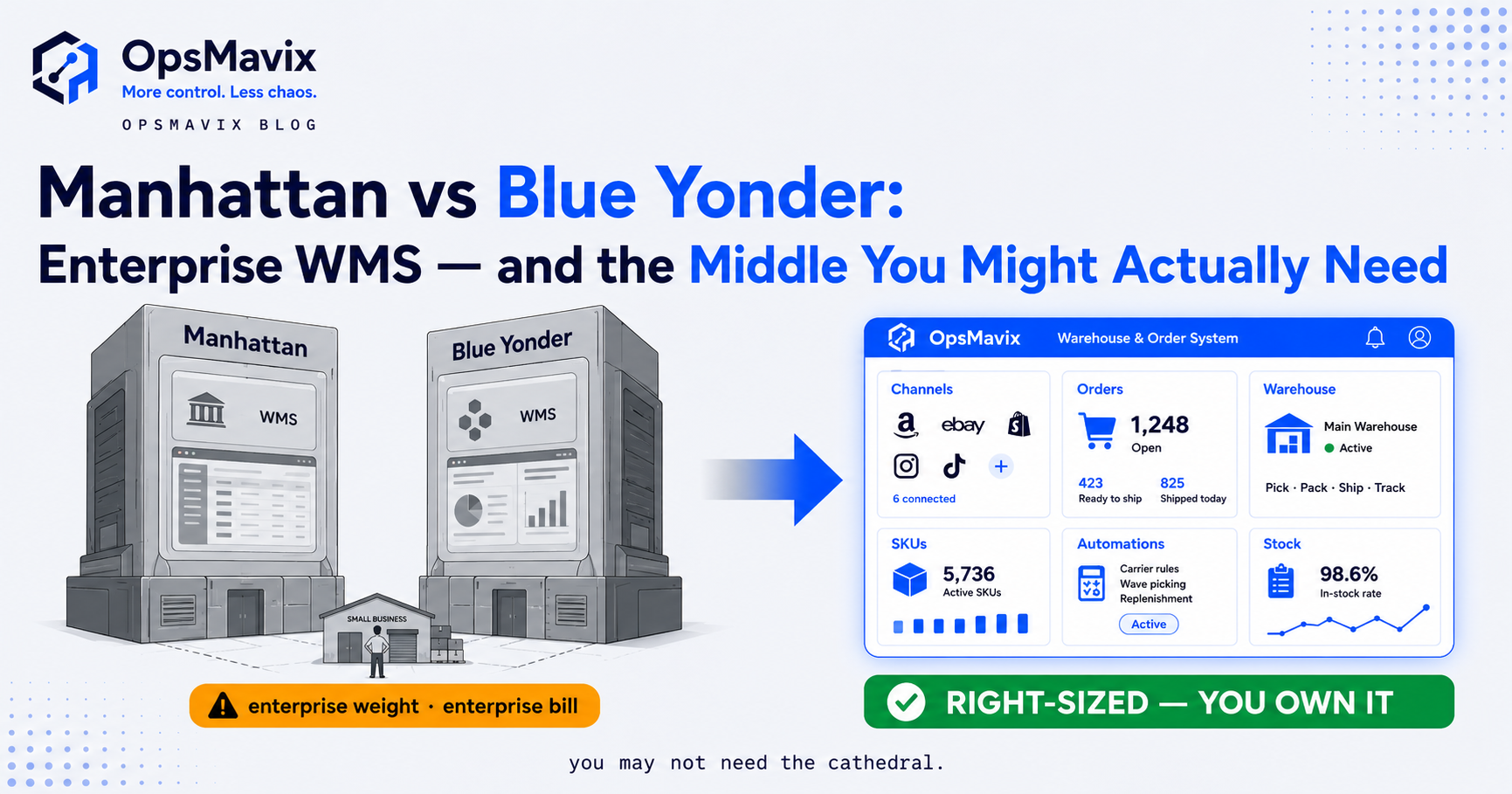
By OpsMavix. Vendor product information checked September 2026.
Your warehouse director wants to bring in an enterprise WMS. The board has asked for a comparison, and two names keep coming up: Manhattan Associates and Blue Yonder. Both get called “market leaders” in every analyst report you can find. Neither publishes a price. You are three weeks into demos and scoping calls and you still cannot say, in plain terms, which one is actually right for your operation, or whether either of them is.
That is the real shape of the manhattan vs blue yonder question. It is rarely a straightforward feature comparison, because both platforms are strong, both are built for the same weight class of operation, and the differences that matter are architectural and organisational rather than a simple list of ticked boxes.
This guide is for UK operations and supply chain teams sizing up Manhattan Active WM against Blue Yonder’s WMS, usually because a consultant, an analyst report or a board member has put both names on the table. It sets out how the two platforms genuinely differ, what they cost in order of magnitude (neither publishes a number, so we will not invent one), and, the part most vendor comparisons skip, an honest read on whether your operation needs either one yet, or whether the real fix is smaller, faster and something you would own outright.
What is Manhattan Active WM?
Manhattan Active WM is the flagship warehouse management platform from Manhattan Associates, a long-established, publicly traded supply chain software company. The defining feature is architectural: it is versionless and built on microservices, so buyers stay on the current release continuously rather than running periodic, disruptive upgrade projects.
Its most distinctive capability is order streaming, a continuous, machine-learning-driven allocation engine that keeps inventory and open orders aligned in real time instead of releasing work in fixed batch waves. Around that sits unified distribution control (fulfilment, labour, slotting and automation managed in one application), an embedded warehouse execution layer for onboarding robotics, and labour management with gamification features that Manhattan reports can lift picker productivity.
The platform is built for large retailers, grocery chains, consumer goods manufacturers, life sciences distributors and third-party logistics providers running complex, high-volume omnichannel fulfilment across multiple sites. It is a genuinely capable system for that weight class of operation, and it is priced and implemented accordingly.
What is Blue Yonder’s WMS?
Blue Yonder’s warehouse management system sits inside its broader Luminate platform, which spans planning, supply chain execution and commerce. The company was acquired by Panasonic, with a majority stake completed in 2021 in a deal reported to value Blue Yonder at several billion pounds, which explains why Panasonic’s hardware and robotics ambitions run through the product roadmap.
Where Manhattan leads with architecture, Blue Yonder leads with artificial intelligence. The system is designed to forecast labour, equipment and asset needs days or weeks ahead, then dynamically reallocate people and automation as conditions on the floor change. Its Robotics Hub is a vendor-agnostic interface for onboarding and balancing multiple robot fleets from different manufacturers alongside human workers on the same floor. Following its 2025 acquisition of Optoro, Blue Yonder has also folded specialised returns management directly into the WMS rather than leaving it as a bolt-on.
Like Manhattan, Blue Yonder targets large, complex, multi-site operations, and it does not publish list pricing either.
Manhattan vs Blue Yonder: the comparison
Strip away the analyst-report language and the two platforms separate on a handful of concrete points.
| Comparison point | Manhattan Associates | Blue Yonder |
|---|---|---|
| Core strength | Order streaming: continuous, real-time allocation across inventory and open orders | AI-driven forecasting of labour, equipment and asset needs, with dynamic reallocation |
| Best-fit business | Large retailers, grocery, consumer goods, life sciences and 3PLs with complex omnichannel fulfilment | Large, complex operations wanting predictive labour and automation planning, plus embedded returns handling |
| Deployment model | Cloud-native, versionless, continuous updates, no scheduled upgrade projects | Cloud-based, delivered as part of the wider Luminate suite |
| Breadth | Warehouse management with embedded execution for onboarding robotics into one application | Warehouse management plus a vendor-agnostic Robotics Hub across multiple robot fleets, and integrated returns via Optoro |
| Ownership and roadmap | Independent, publicly traded, focused on supply chain commerce | Owned by Panasonic since 2021, roadmap tied to Panasonic’s hardware and robotics strategy |
| Implementation reality | Long, consultant-led scoping and configuration against your own SKUs, order profiles and automation | Same weight class: long, consultant-led scoping, typically alongside the wider Luminate estate |
| Pricing approach | Quoted on request, scoped to throughput, sites and automation | Quoted on request, scoped the same way |
Both platforms are credible for the operations they are built for. Choosing between them is a genuine, months-long evaluation, usually run with a consultant, scripted demos against your own data, and reference calls with existing clients in your sector. That process, on its own, tells you something about the scale of commitment either purchase represents.
Architecture versus intelligence: the philosophical split
The clearest way to separate the two platforms is by what each one is selling as its core advantage. Manhattan sells the absence of upgrade pain: a versionless architecture means the platform you are on today is the platform you are on next year, with no multi-month re-implementation cycle every few releases. That matters enormously to a large IT function managing dozens of integrations, because upgrade projects on legacy WMS platforms have historically been expensive and risky in their own right.
Blue Yonder sells foresight. Its pitch is that a warehouse should see its own bottlenecks coming, a labour shortfall flagged days before it hits the floor rather than discovered when orders start slipping. That is a genuinely different value proposition, and it leans on the machine-learning capability Blue Yonder has built across its wider Luminate planning suite, not just the warehouse module in isolation.
Neither philosophy is wrong. They suit different organisational priorities: pick Manhattan if platform stability and a single, tightly integrated application matter most; pick Blue Yonder if predictive planning and multi-fleet robotics orchestration matter most. Most buyers weighing manhattan vs blue yonder end up choosing based on which philosophy matches how their operations leadership already thinks, more than on any single feature.
Automation and robotics: embedded versus agnostic
Both platforms assume you already have, or plan to have, automation and robotics on the floor. They handle it differently. Manhattan embeds a warehouse execution layer directly inside Active WM, so bringing on new automation happens inside the same application that runs fulfilment, labour and slotting. Blue Yonder’s Robotics Hub takes the opposite approach: it is explicitly built to sit above multiple robot fleets from different vendors and balance them, alongside human labour, rather than assuming a single automation partner.
If you already run automation from several suppliers, or expect to, Blue Yonder’s vendor-agnostic approach is worth weighing seriously. If you would rather manage automation inside one unified application with fewer moving integration parts, Manhattan’s embedded model is the more contained choice. Either way, this is a decision that only matters once automation is actually on your floor or firmly on your roadmap, not a hypothetical.
What both actually cost, and why neither vendor prints it
Neither Manhattan nor Blue Yonder publishes pricing, and that is a deliberate feature of how enterprise software is sold at this level, not an oversight. Enterprise WMS deals are shaped around your throughput, site count, integrations, degree of automation and length of contract, so a number only exists once a vendor has scoped your specific operation.
What can be said honestly, without inventing a figure for either vendor, is the shape of the cost. Publicly available case studies, analyst commentary and industry reporting on large warehouse management implementations consistently describe total costs, once licensing, implementation, integration, data migration and change management are combined, reaching well into six figures for a single site and into seven figures for multi-site, automation-heavy rollouts. The software licence is frequently the smaller line. The implementation, getting the platform correctly configured against your own SKUs, order profiles, integrations and automation, is where the majority of the budget and the majority of the timeline go, and multi-month to multi-year rollouts are the norm rather than the exception at this tier.
That is entirely justifiable for an operation where a few percentage points of throughput or labour efficiency is worth millions a year. For a business several sizes smaller than that, it is a lot of money and a lot of time to spend answering a question the business was not actually asking.
When neither is the right fit
Here is the question most manhattan vs blue yonder comparisons skip: does your operation actually need an enterprise WMS at all yet?
An enterprise WMS is built to squeeze marginal efficiency out of an operation that is already industrialised, already running high volume across multiple sites, already has automation on the floor that needs orchestrating. If that describes you, both platforms are worth the months of evaluation. If it does not, and the honest picture is stock counts that drift, pickers walking routes based on a spreadsheet nobody trusts, orders re-keyed by hand between two systems that never learned to talk to each other, then you do not have a marginal-efficiency problem. You have a connection problem, and it is a different, considerably cheaper problem to fix.
Putting a platform priced and built for a multi-site, automation-heavy enterprise on top of a process that is still held together with spreadsheets does not fix the process. It just means the mess now has an enterprise price tag attached to it.
Between “spreadsheets and disconnected tools” and “a multi-year, seven-figure enterprise WMS rollout” there is a gap the big vendors do not serve, because it genuinely is not their market. That gap is one operations system that connects stock, orders, purchasing, production and reporting into a single accurate view, shaped to how your warehouse actually runs, and handed over to you as something you own outright rather than licence indefinitely.
This is not a stripped-down Manhattan or a smaller Blue Yonder. Trying to be a budget version of an enterprise platform is a trap, because you inherit the complexity without the scale to justify it. A right-sized operations system for inventory does something different in kind: it does exactly what your stock, orders and warehouse floor need, nothing you will never open, at a fixed project cost rather than a per-seat licence that runs for as long as you use the platform.
Worked example: a Yorkshire distributor sizing the wrong question
A Yorkshire-based industrial fasteners distributor, single site, around 45 warehouse staff, roughly £11 million in annual turnover, had spent five months scoping Manhattan and Blue Yonder in parallel. Both vendors had run demos, both had asked for SKU counts, order profiles and automation plans, and both were converging on quotes the finance director expected to land somewhere in the low seven figures once implementation was included.
Sat down with the actual daily problem, the picture looked different. Stock accuracy on the warehouse floor was genuinely poor, off by five to eight per cent on a rolling count, because goods-in was recorded on paper and reconciled into a spreadsheet once a day. Pickers worked from printed pick lists that lagged the morning’s order changes. Purchasing had no live view of what was actually on the shelf against what was committed to open orders, so reorders were either too early or, more often, too late. None of that required AI-driven labour forecasting or a vendor-agnostic robotics hub, because there was no automation on the floor to orchestrate in the first place.
The business had one site and no robotics roadmap for at least three years. What it needed was accurate, real-time stock counts, pick lists that updated the moment an order changed, and one live view connecting purchasing to the shelf. A right-sized operations system covering exactly those three areas, wired into the warehouse management and finance tools already in place, was scoped and delivered in a matter of weeks, at a fraction of either enterprise quote, and the business owns it outright. Manhattan and Blue Yonder were not the wrong vendors. They were the right answer to a question this particular business was not yet asking.
A practical checklist for choosing
Work through these before committing months to an enterprise WMS evaluation, or before assuming you need one.
- Write down the specific failures happening today on your warehouse floor, in plain language, not “we need better systems”.
- Count your sites and check whether automation or robotics is actually on the floor, or firmly funded and scheduled, not just discussed.
- Ask whether the pain is marginal efficiency at scale, or basic accuracy and connection between tools that should already talk to each other.
- Get a realistic all-in estimate, licensing plus implementation plus the internal time an evaluation will consume, before assuming either platform is affordable or necessary.
- Check what you would own at the end of the process: a licensed platform you keep paying for, or a system that is handed over as yours.
- Map what needs to connect to what you already run before any vendor, enterprise or otherwise, is allowed to promise it will.
Frequently asked questions
Is Manhattan or Blue Yonder better?
Neither is universally better. Manhattan leads on architecture, a versionless platform with continuous updates and its order streaming allocation engine. Blue Yonder leads on AI-driven forecasting and vendor-agnostic robotics orchestration. The right one depends on which capability matters more to your operation and how your team already thinks about the problem.
How much does Manhattan Active WM cost?
Manhattan does not publish pricing. Quotes are scoped to your throughput, site count, integrations and automation, and industry reporting on large implementations describes total costs, licensing plus implementation combined, reaching well into six and sometimes seven figures. Request a scoped quote directly rather than relying on any published figure.
How much does Blue Yonder WMS cost?
Blue Yonder also does not publish pricing for its WMS. As with Manhattan, expect a scoped, consultant-led quote once your operation’s size and complexity are known, and expect the implementation to be the larger cost line rather than the licence itself.
Do I need an enterprise WMS like Manhattan or Blue Yonder?
Only if you are running high volume across multiple sites, with automation or robotics already on the floor or firmly funded, and your pain is marginal efficiency at industrial scale. If your actual problem is stock accuracy, disconnected tools or manual reconciliation, an enterprise WMS is answering a question you have not yet reached.
What is the difference between a WMS and a broader operations system?
An enterprise WMS like Manhattan or Blue Yonder is built to run warehouse execution at large scale, allocation, labour, slotting and robotics, for operations that have already industrialised. A right-sized operations system connects the specific areas that are actually broken, stock, orders, purchasing, production or reporting, without the scale, cost or implementation timeline of an enterprise platform.
Can a smaller operation grow into Manhattan or Blue Yonder later?
Yes, and that is often the sensible path. Fix the accuracy and connection problems now with a system sized to today’s operation, then move to an enterprise WMS when volume, site count and automation genuinely justify it. Far fewer businesses reach that point on the timeline the sales process suggests.
Why do neither Manhattan nor Blue Yonder publish prices?
Because enterprise WMS deals are shaped individually around throughput, site count, integrations, automation and contract length. A single published number would not reflect what most buyers actually pay, so both vendors scope and quote after a discovery process.
How OpsMavix can help
OpsMavix builds operations systems for UK businesses that move physical products, connected stock, orders, purchasing, production and reporting, shaped to how your warehouse and your team already work, and full ERP systems when a business is genuinely at that scale.
Go back to the question at the start: are you comparing Manhattan and Blue Yonder because your operation has outgrown a marginal-efficiency ceiling at genuine scale, or because stock counts drift, pick lists lag and nobody trusts the numbers on the shelf? The two situations call for very different answers, and it is worth knowing which one you are in before either vendor’s clock starts running.
Bring the honest picture to a free Operations Leak Audit. We map how your warehouse and back office actually work, show where the leak really sits, and give you a straight read on whether that means a right-sized inventory and stock system, or genuinely means an enterprise WMS evaluation like the one you have already started. You can also check our current project price bands before getting in touch. Either way, the decision should follow the problem you actually have, not the size of the platform two vendors have put in front of you.